Néon Flap
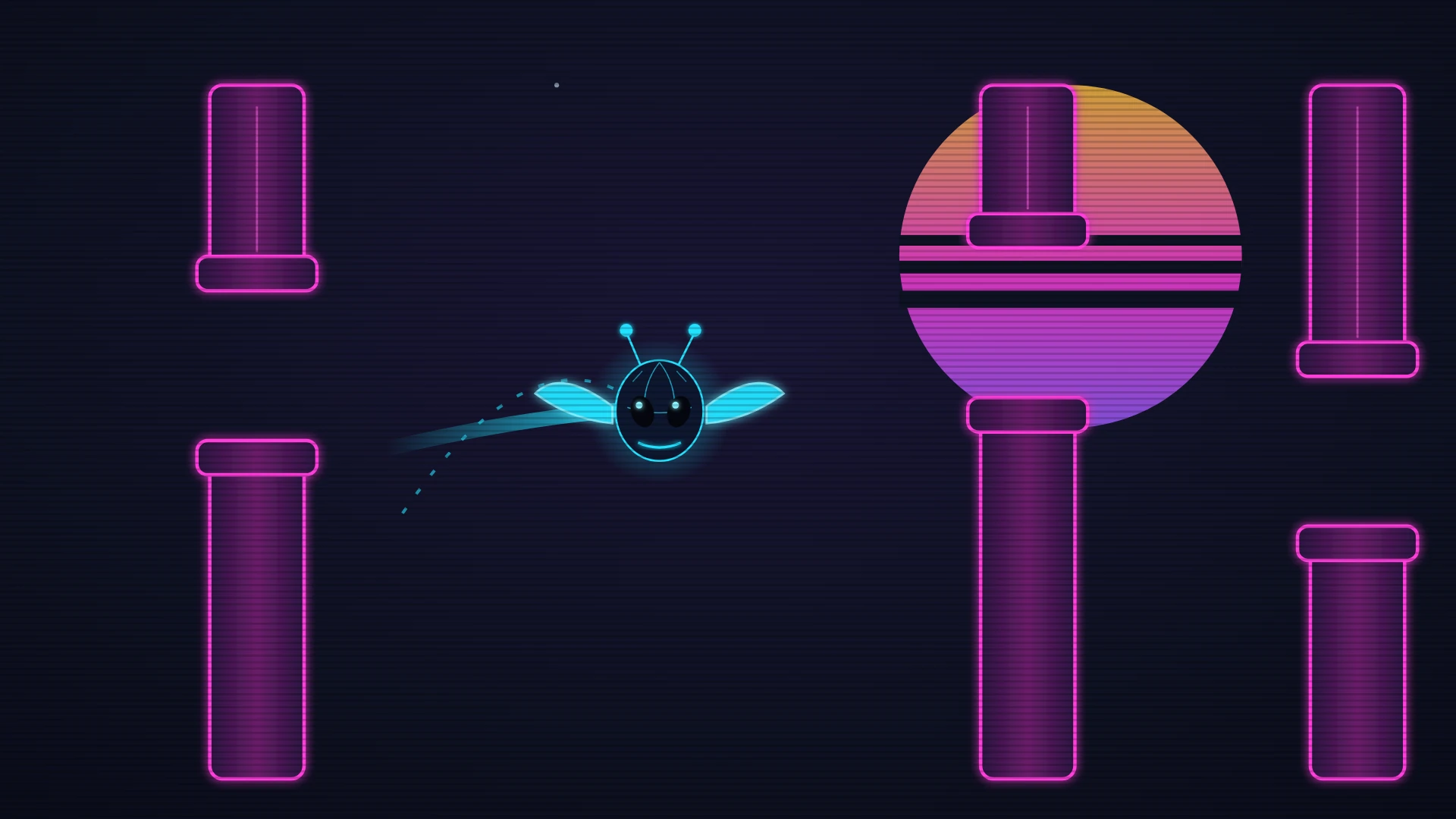
One tap, one flap: guide a paper lantern between electrified pylons, from the city rooftops up to the aurora. Easy to start, hard to stop.
Read the rules below, then start your run.
About this game
Néon Flap is a one-tap arcade game: one action, constant tension. You fly a paper lantern whose cyan flame lights up the night. Every press — a tap with a finger or the mouse, the spacebar or the up arrow — gives it a flap that pushes it upward; between flaps, gravity pulls it back toward the ground. The lantern keeps its place on screen and the world scrolls toward it: electrified metal pylons, each with a gap you must slip through without touching anything. Hit a pylon, the floor or the ceiling of the flight area and an electric arc sets the paper alight: the lantern turns to ash and the run is over. Your score is the number of pylons cleared (the scoreboard calls them “gates”). The backdrop tells the story of your climb. The game passes through five altitudes: you start on the Rooftops, enter the Clouds at the 8th pylon, cross the Storm — rain and lightning — from the 18th, emerge Above the clouds at the 32nd, then reach the Aurora at the 50th. Every pylon cleared is worth 20 metres of altitude, shown on the end screen with your zone and your gate count. The difficulty follows its own curve, in nine steps: the scroll speeds up from 190 to 310 pixels per second and the gap between pylons narrows from 240 to 150 pixels. The lantern’s collision radius is 18 pixels against 24 for its drawing: the paper can brush a pylon without it counting. The sound follows your flight. Each pylon cleared rings a bell on the E Phrygian scale and the note climbs one step per pylon (ten notes, then the tune starts over); the music plays in the same mode, and each new altitude is announced by an arpeggio of bells. If you touch nothing, the run starts by itself after 1.5 seconds. Néon Flap is free in your browser, nothing to install, on a keyboard at your desk or with a finger on mobile: the whole screen is a tap zone. Create an account to sync your records, enter the leaderboards and unlock trophies. How high will you climb?
Your take
Sign in to react to this game in one click — nothing to write:
- Love it! 🔥
- More games like this! 🙌
- One of my favourites! ❤️
How to play
Fly your paper lantern as far as you can: clear as many electrified pylons as possible without touching a thing and climb from altitude to altitude, from the rooftops to the aurora.
Game rules
- Your lantern keeps its place on screen: the world scrolls toward it, with electrified metal pylons that each have a gap.
- Every press gives it a flap that pushes it upward; without a press, gravity pulls it back down.
- Line up with the gap in each pylon and slip through at the right moment — not too high, not too low.
- Every pylon you clear (a “gate” on your scoreboard) adds a point to your score.
- The backdrop changes altitude with your score: Rooftops at the start, Clouds at 8, the Storm (rain and lightning) at 18, Above the clouds at 32 and the Aurora at 50.
- The difficulty rises in 9 steps: the scroll speeds up from 190 to 310 pixels per second and the gap between pylons narrows from 240 to 150 pixels.
- If you touch nothing, the run starts by itself after 1.5 seconds.
Controls (keyboard and touch)
- Spacebar or Up arrowFlap (climb)
- Click / Tap anywhereFlap with a finger or the mouse
How a run ends
There is no finish line: the run stops the instant the lantern touches a pylon, the floor or the ceiling of the flight area — the electric arc sets it alight and it falls to ash. The end screen shows your gates cleared, your altitude (20 metres per pylon) and the zone you reached. The only goal is to beat your own record.
Tips & strategy
Short, steady flaps
Chain short presses rather than one late, forced flap. Every press sets the climb to the same speed whatever your current speed, so it is better to correct often and gently than to overcorrect once.
Watch the next pylon
Keep your eyes on the coming gap, not on the lantern. Reading the height of the next opening early saves you from the last-second corrections that end runs.
Aim for the middle of the gap
The lantern’s collision radius (18 pixels) is a little smaller than its drawing (24 pixels), but do not count on it to shave pylons. When the gap narrows towards 150 pixels, the margin in the middle is the whole difference.
Ignore the storm
From the 18th pylon, rain and lightning animate the backdrop. They change neither your trajectory nor your score: keep your eyes on the gaps, not on the flashes.
Did you know?
The one-tap side-scroller blew up in 2013 with Flappy Bird, made by Vietnamese developer Dong Nguyen. Its brutal difficulty and single-button design turned it into a viral hit before its author pulled it from the stores himself in early 2014.
The idea of a character kept aloft by tapping is older, though: Flash games such as Helicopter Game were already built on that single control where letting go means falling. Néon Flap runs on the same permanent tug-of-war between gravity and thrust, with a paper lantern as its only light.
The bell melody is built on the E Phrygian mode, the one whose second note is lowered by a semitone: it is what gives the game its tense night-time air. The ten notes the pylons walk through all stay inside that mode.
Frequently asked questions
- Is Néon Flap free to play?
- Yes. Néon Flap is completely free and runs straight in your browser — no download, no install, no paywall.
- How do you play Néon Flap?
- Hit “Play” to start Néon Flap. It runs on keyboard on desktop and on touch controls on phones and tablets — no controller needed.
- Do I need an account to play?
- No — you can play right away as a guest, and your best score is kept on this device. A free account (by email link, no password) syncs your high scores, puts you on the leaderboards and unlocks trophies.
- Does Néon Flap work on mobile?
- Yes. The game is responsive and fully playable with your fingers on phones and tablets, just like on desktop, with no app to install.
- Why does my lantern shoot up so suddenly?
- Every flap replaces your vertical speed with a fixed climb of 460 pixels per second: presses do not add up. If you climb too much, you are pressing too often and the lantern keeps rising. Let gravity (1,500 pixels per second squared) bring the lantern back down between presses.
- Do the gaps really get tighter?
- Yes: the difficulty rises in 9 steps, the last of which arrives at the 100th pylon. The scroll speeds up from 190 to 310 pixels per second and the gap narrows from 240 to 150 pixels. Beyond the 100th pylon the difficulty stops rising.
- What are the altitudes for?
- They mark your progress: Rooftops, Clouds (from 8 pylons), Storm (18), Above the clouds (32) and Aurora (50). Each pylon cleared is worth 20 metres. It is a visual landmark: the altitudes do not follow the difficulty curve, which has its own steps.