Néon Nonogram
The nonogram in retro neon: fill the cells from the clues to reveal the hidden picture. 3 grid sizes, and your score is your solving time.
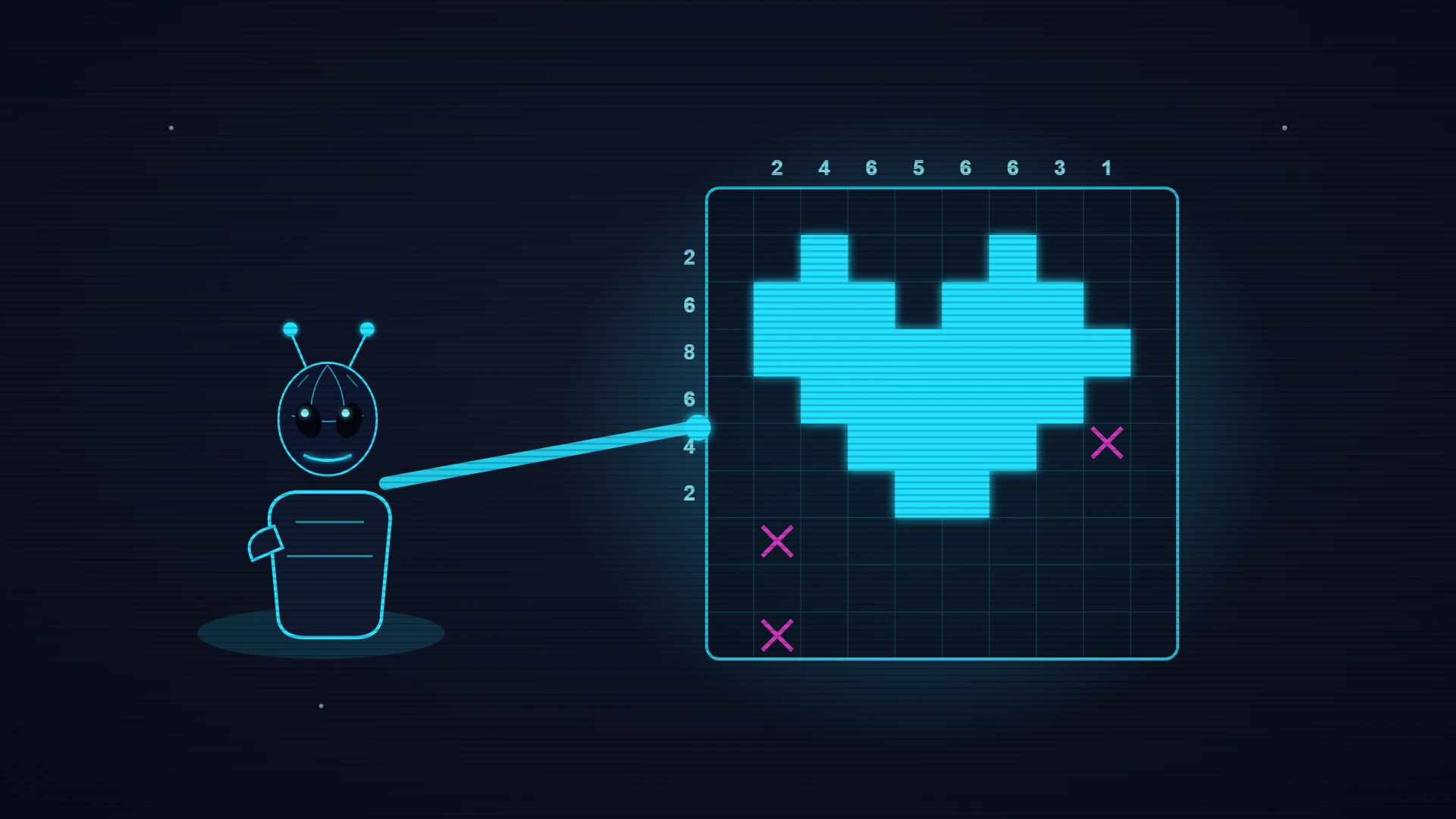
Read the rules below, then start your run.
About this game
Néon Nonogram is the famous Japanese logic puzzle — the nonogram, also called griddler or hanjie — dressed in a polished retro-neon skin and built to play with a mouse or a finger. The idea is crisp and horribly addictive: a square grid of empty cells and, all around it, series of numbers that are your only clues. Each number on a row gives the length of a run of cells to fill in a row, in order, from left to right; each number on a column does the same from top to bottom. So a clue of "2 1" on a row means a run of two filled cells, then, further along, a run of one, separated by at least one empty cell. It is on you to cross-reference the row and column clues, by pure logical deduction, to work out which cells to fill and which to leave blank. No blind guessing: every grid has a single solution, guaranteed at generation by a solver that checks uniqueness, and it is entirely deducible by reasoning. Little by little, as you rule out the impossible and confirm the certain, a pixel drawing appears under your hands. To help you think, you have two gestures: a short press fills or clears a cell, and a long press (or a right click on a computer, or cross mode from a button) puts a cross on the cells you are sure you want to leave empty — a valuable visual aid that never affects the win, only your clarity. The puzzle is won as soon as the set of cells you have filled matches the solution exactly, no more and no less; there is no penalty and no punishment, the final picture simply has to be right. Play at your own pace or against the clock: your score is your solving time, so the faster you fill the grid, the better your record (the shortest clock wins). The timer starts on your first press on the grid and stops dead when the picture is complete. Three grid sizes suit your mood and your level: Easy at 5×5 to learn and unwind, Medium at 7×7 for a proper but approachable logic challenge, and Expert at 10×10 for seasoned solvers going for the top of the leaderboard. Play with a mouse at your desk or with a finger on mobile, with robust touch controls built for the thumb, and a neon look designed for instant readability: bright filled cells, crisp crosses and well-contrasted clues, smooth at 60 frames per second. Néon Nonogram is free and instant in your browser, nothing to install. Create an account to sync your best times, enter the leaderboards and unlock trophies as you solve grids faster and faster. Can you crack the 10×10 Expert in record time?
Your take
Sign in to react to this game in one click — nothing to write:
- Love it! 🔥
- More games like this! 🙌
- One of my favourites! ❤️
How to play
Work out which cells to fill from the numeric clues around the grid to reveal a pixel picture, as fast as you can.
Game rules
- Each number at the head of a row or column gives the length of a run of filled cells, in the order the numbers are written.
- Several numbers mean several runs separated by at least one empty cell: "2 1" means a run of two, a gap, then a run of one.
- Cross-reference rows and columns: a cell is only certain when both axes agree, so work by successive deductions.
- Mark the cells you know stay empty with a cross: that memo does not affect the win, but it keeps your reasoning straight.
- The solution is unique and entirely deducible: no guesswork is ever needed.
- Pick your grid size: Easy 5×5, Medium 7×7 or Expert 10×10, depending on the challenge you want.
Controls (keyboard and touch)
- Short press (finger or left click)Fill a cell or clear it
- Long press, right click or cross modePut a cross on a cell you know is empty
How a run ends
You win as soon as the cells you have filled match the solution exactly: there is no penalty for a mistake, but the clock keeps running. Your score is your solving time, and shorter is better.
Tips & strategy
Start with the big numbers
A clue close to the width of its line leaves very little freedom. On a ten-cell row, an "8" forces at least six filled cells in the middle whatever the offset: those certainties get the whole deduction moving.
Work the full and empty lines
A line whose clues plus the compulsory gaps add up to its width fills completely. Conversely, a "0" or a line with no clue at all can be crossed out end to end straight away.
Alternate rows and columns
Do not grind away on one axis. The moment a deduction stalls, switch to the crossing columns: a cell you filled a moment ago often unlocks a new certainty on the perpendicular axis.
Did you know?
The nonogram, also called hanjie or griddler, appeared in Japan in the late 1980s. The idea turned up in logic puzzle magazines before reaching consoles; it is sometimes called by the Japanese word "oekaki", which simply means "drawing" — because the solved grid is not an end in itself, it reveals a picture.
The genre spread worldwide through the 1990s on handheld consoles, which fixed the conventions still in use: numeric clues along the edges, cells to fill and exclusion crosses for the cells you know are empty. That is what sets it apart from other logic games: unlike a grid of numbers, the final reward is visual — a pixel drawing uncovered cell by cell.
Frequently asked questions
- Is Néon Nonogram free to play?
- Yes. Néon Nonogram is completely free and runs straight in your browser — no download, no install, no paywall.
- How do you play Néon Nonogram?
- Hit “Play” to start Néon Nonogram. It runs on keyboard on desktop and on touch controls on phones and tablets — no controller needed.
- Do I need an account to play?
- No — you can play right away as a guest, and your best score is kept on this device. A free account (by email link, no password) syncs your high scores, puts you on the leaderboards and unlocks trophies.
- Does Néon Nonogram work on mobile?
- Yes. The game is responsive and fully playable with your fingers on phones and tablets, just like on desktop, with no app to install.
- Am I penalised for filling the wrong cell?
- No, there is no penalty for a mistake: you can freely correct a cell you filled wrongly. The clock does not stop, though, so feeling your way costs you time and hurts your final score.
- What are the crosses for if they do not count towards the win?
- The crosses are a reasoning tool: they mark the cells you have deduced are empty so you never reconsider them. Only the filled cells decide the win, but ruling the empties out properly speeds up a solve enormously.