Néon Flow
Against the clock on a circuit board: link the colour pairs by drawing light traces, without crossing, until the grid is full. Every level solved buys time. Chain as many as you can before the clock runs out.
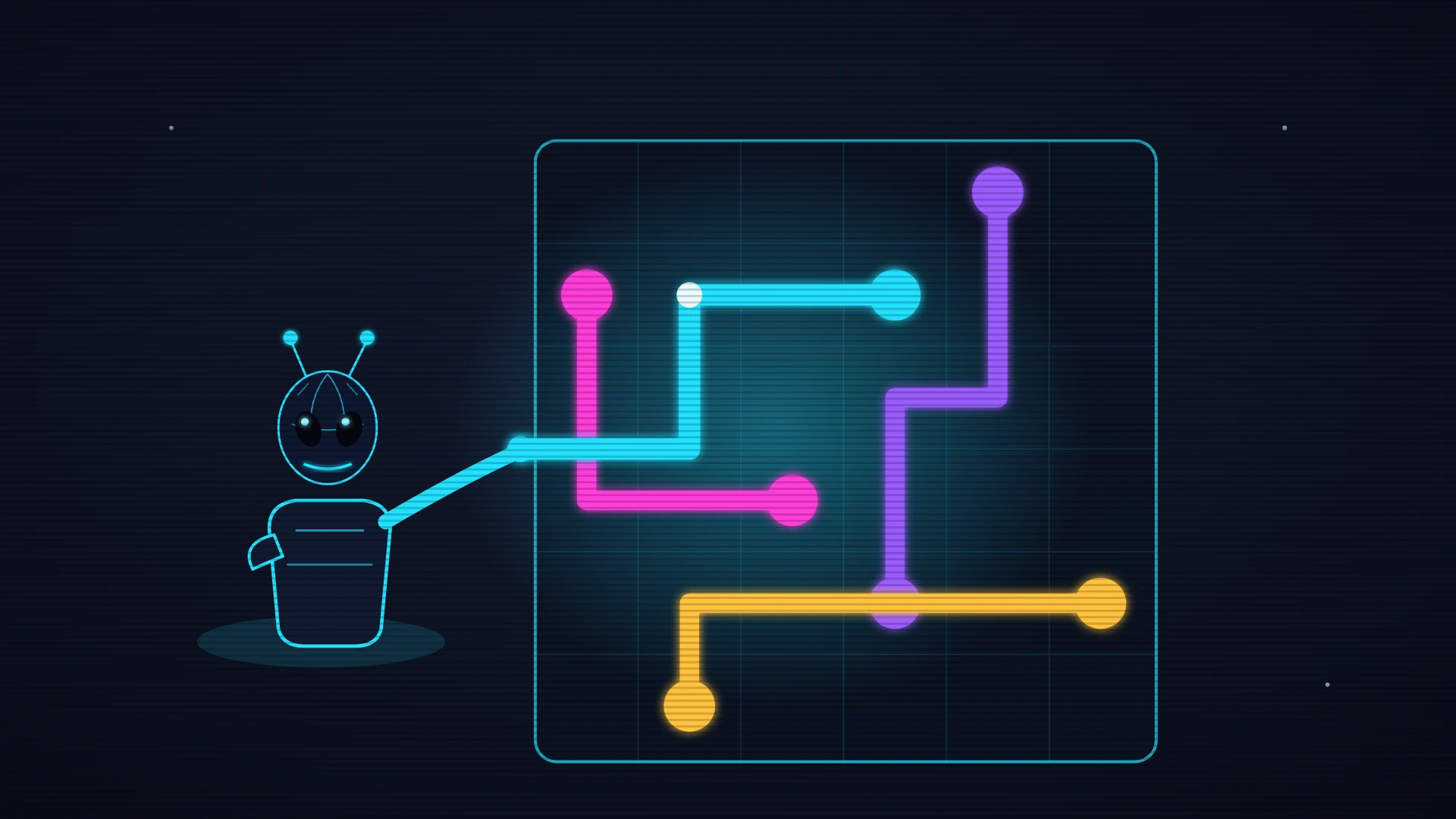
Read the rules below, then start your run.
About this game
Néon Flow is a connection puzzle played AGAINST THE CLOCK: you restore the current of a printed circuit by drawing traces of light. The backdrop is an electronic board in teal and gold, with etched tracks leaving the playfield, big blurred chips in the distance, silhouetted components, soldered vias and seven small signals slowly travelling the longest tracks. The current lights up across the board as you link pairs, bursts at every solved grid and goes out when time runs out. On a square grid, pairs of coloured dots wait to be joined. For each colour, draw a glowing glass pipe between its two ends by dragging your finger, or the mouse, from cell to cell, horizontally or vertically only, never diagonally. The golden rule: pipes cannot cross, and a level is only solved when EVERY pair is linked AND EVERY cell of the grid is covered by a pipe. That double objective turns plain tracing into a puzzle of order and foresight: you will often have to undo one path to make room for another. Drawing is forgiving without starting over: go back over your own path to retract it, or pick your pipe up in the middle and carry on from there. If you cross another colour's pipe, you wipe it from the point you cut in and it is up to you to rebuild it. Every pair linked sets off a flash of light, and the note of the trace rises as the pipe grows longer. Everything here is a race against the clock. The run starts with 45 seconds on the counter, and every level solved hands 12 seconds back, never going over a 90-second cap. The clock only starts at your very first stroke: you can scan the pairs calmly, and on the very first grid a ghost hand shows you the gesture. Under 10 seconds, the counter turns red and pulses. When it hits zero, the run is over. The difficulty climbs level after level: the first level is a 5×5 grid with 3 colours, then the grid grows one cell a side up to 8×8 with 6 colours to link, and the later levels keep adding colours up to a maximum of 8. The next grid follows automatically after the wave of light celebrating your solve, and every generated level is guaranteed solvable by construction. Your score is the number of levels you solve before time runs out: the more you chain, the higher you climb. To stay readable with colour blindness, each colour also carries a distinct shape on its starting dots: circle, square, triangle, diamond, cross, star, hexagon and hourglass. Néon Flow is free and instant in your browser, nothing to install, on desktop and mobile alike. Create an account to sync your high scores, enter the leaderboards and unlock trophies as you solve levels. How far will you get?
Your take
Sign in to react to this game in one click — nothing to write:
- Love it! 🔥
- More games like this! 🙌
- One of my favourites! ❤️
How to play
Link every pair of same-coloured dots with a pipe of light and fill the whole grid without any pipe crossing — all against the clock.
Game rules
- The grid holds several pairs of coloured dots, set on an electronic board: for each colour, draw a pipe linking its two ends. Each colour also carries a shape (circle, square, triangle, diamond, cross, star, hexagon, hourglass).
- Drag from cell to cell horizontally or vertically only, never diagonally, to unroll the pipe from a dot.
- Pipes cannot cross: running through another colour's pipe wipes it from the point you cut in.
- Go back over your own path to retract it, or pick your pipe up in the middle and carry on from there, without starting over.
- The level is solved when every pair is linked AND every cell of the grid is covered by a pipe: a double objective.
- The whole run is a race against the clock: the timer starts at your first stroke (not when the grid appears) with 45 seconds on the counter, and every level solved hands 12 seconds back before moving on automatically to the next, never going over 90 seconds. Under 10 seconds, the counter turns red.
- The difficulty climbs gradually: a 5×5 grid with 3 colours on the first level, then bigger grids up to 8×8 (6 colours), with up to 8 colours to untangle after that; every generated level stays solvable.
Controls (keyboard and touch)
- Mouse (hold click + drag)Draw a pipe from a coloured dot, cell by cell
- Finger (continuous drag)Unroll or retract the pipe by following the path you want
How a run ends
The level is won as soon as every pair is connected and the grid is completely filled, which hands you 12 seconds back. Within a level you can retract and redraw as much as you like: the run, though, ends when the clock hits zero. Your score is the number of levels solved before time runs out.
Tips & strategy
Start from the corners and edges
A dot sitting in a corner has only two possible exits, sometimes one. Starting with those constrained cells locks in portions of the path for certain and massively cuts the number of combinations to explore.
Never forget to fill everything
Linking the pairs is not enough: every cell must be covered. If a cell stays empty, a pipe has to detour to cover it, often by hugging the edge rather than cutting straight across.
Spot the forced corridors
Some cells can only be crossed by one colour given the geometry. Identify these forced passages first: they decide the path of the neighbouring pipes and unlock the rest of the grid.
Speed IS the score
The clock is what ends the run, so a level finished fast is a level that pays for the next. The starting 45 seconds are topped up by 12 per level, capped at 90: there is no point hoarding time beyond that, better to reinvest it by chaining.
Use the stopped clock
The clock only starts at the first stroke of the run. Before touching the grid, take the time to spot the pairs and the constrained cells: that reading time costs nothing.
Did you know?
The principle of joining pairs of dots without crossing while filling the whole surface is an old logic puzzle, sometimes attributed to the "Number Link" puzzle published by Japanese publishers from the late 19th and 20th centuries. It is a cousin of the planar-graph puzzles studied in mathematics.
The genre had a massive mobile hit with "Flow Free", released in 2012, which popularised dragging a finger to draw the connections. Its total-coverage constraint — link AND fill — sets it apart from simple mazes and makes it a real exercise in spatial optimisation.
Frequently asked questions
- Is Néon Flow free to play?
- Yes. Néon Flow is completely free and runs straight in your browser — no download, no install, no paywall.
- How do you play Néon Flow?
- Hit “Play” to start Néon Flow. It runs on keyboard on desktop and on touch controls on phones and tablets — no controller needed.
- Do I need an account to play?
- No — you can play right away as a guest, and your best score is kept on this device. A free account (by email link, no password) syncs your high scores, puts you on the leaderboards and unlocks trophies.
- Does Néon Flow work on mobile?
- Yes. The game is responsive and fully playable with your fingers on phones and tablets, just like on desktop, with no app to install.
- Do I really have to fill every cell, or just link the dots?
- Both are required. Linking every colour pair is necessary but not sufficient: as long as a single cell is empty, the level is not validated. That double constraint is what makes the puzzle interesting.
- How does the Néon Flow clock work?
- You start with 45 seconds and every level solved hands 12 back, never going over a 90-second cap. Grids go from 5 cells a side to 8, with more and more colours to untangle. When the counter hits zero the run ends and your score is the number of levels solved.
- Why does the clock not start as soon as the grid appears?
- The clock only starts at your very first stroke (the first dot you touch), not when the grid appears: you can scan the pairs calmly before you jump in. On the very first grid, a ghost hand shows you the gesture until you play.
- What happens if my pipe runs over an existing trace?
- If it is your own pipe, you retract it by going back. If it is another colour, your pass wipes that pipe from the point where you cut across it: you will have to redraw it, so plan to avoid collisions.